Unknown's avatar

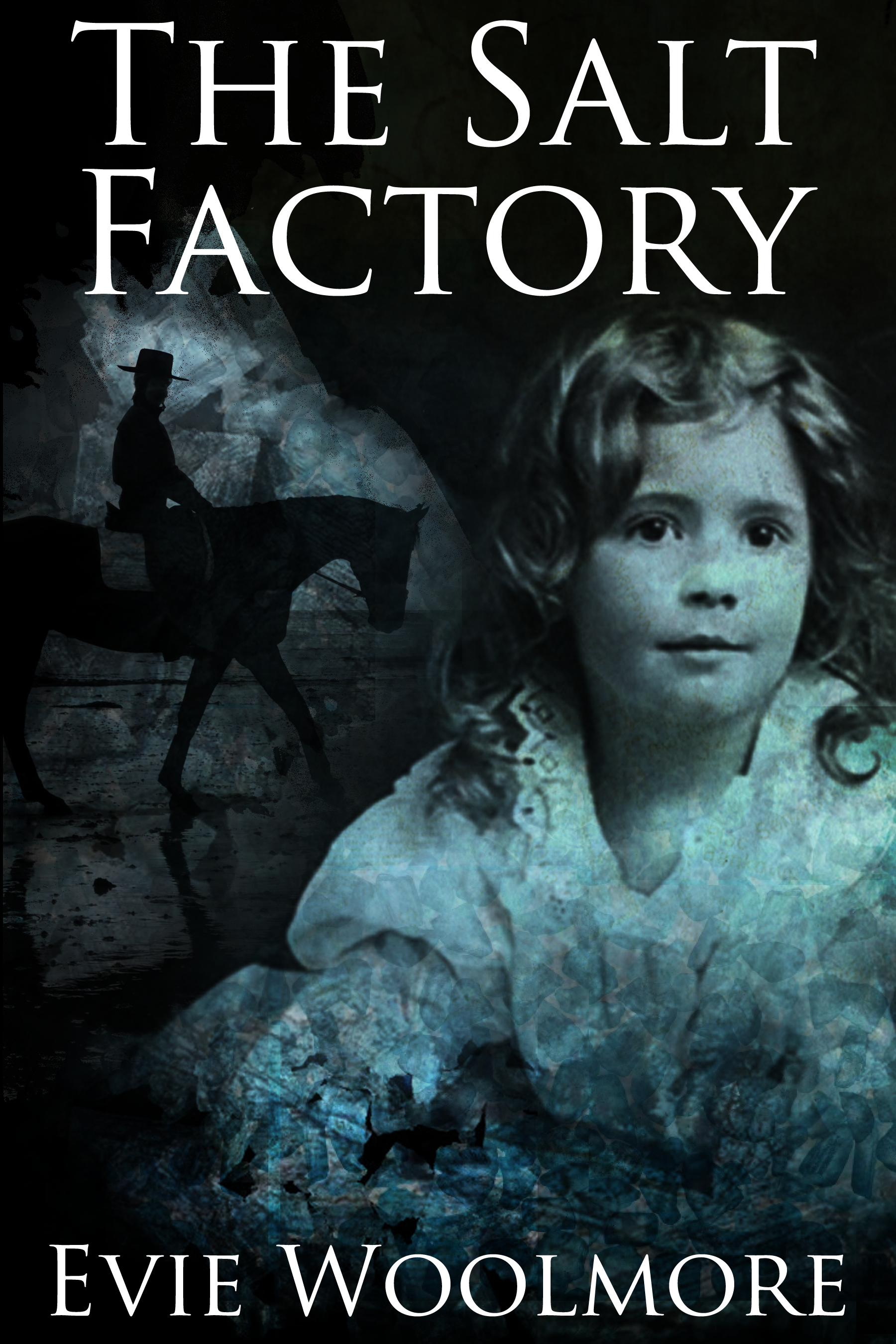
The Salt Factory by Evie Woolmore: new to Kindle next week

This week, Evie Woolmore discusses her new historical magical realist novel, The Salt Factory.

salty9_optionI was chatting to a friend the other day about my books and she asked, as people sometimes do, ‘Where do you get your ideas from?’ I was able to answer, quite honestly, that the original idea for The Salt Factory came so long ago, that I can hardly remember. But it is a novel that, despite the agonies of plotting and rewriting, I have absolutely adored throughout.

As a reader, it is just the sort of novel I enjoy. It is a bubble of a world where time slows down and all the things we took for granted slowly stop being true. It captures that feeling of falling in love, of permanent change, of the dawning of a completely new perspective on the world. All those things happen to Thelonia Jones in one way or the other, and yet the novel isn’t really about any of them. It is, in the manner of all my novels, a book that seems to be about one story and ends up really being about another.

As Lector’s Books pointed out in my interview with them a couple of weeks ago, my novels do tend to have a twist in the tail, not in the sense of a thriller or a crime novel but in a subtle slide in the way the world is revealed. Unlike the writers whose magical realist works I admire, such as Erin Morgenstern or Carlos Ruiz Zafon, I do not simply present my alternative world as is, without explanation, because for me the explanation Continue reading

Unknown's avatar

Reviewing Indie Books: The stories so far…

As we re-open the review list for indie authored books this week, allonymbooks author Evie Woolmore reflects on what she has learned so far about indie publishing from reviewing.

As a rule, I enjoy reading book reviews. I scan the pages of the main British newspapers two or three times a week, looking not only for the formal recommendations but also the reader-recommended novels. I read those little cards on the shelves in Waterstones written by their staff, and I read other book reviewers’ blogs. I even read The Economist‘s arts section to see which book they have allowed to rise to the top of the pile. If they are reviewing a fiction book, it’s usually interesting (if not good).

But do I ever read the books that are recommended by others?

That’s an obvious reason for reading a review, to get a recommendation. But let me give you the other reason I read reviews. Because they tell you so much about the reviewer too. Continue reading

Unknown's avatar

Evie Woolmore’s interview with Lector’s Books

Lector’s Books tells a wonderful tale of how a book can enchant you so much that you put your life on hold to read it straight through from start to finish. Fortunately for me, the book in question was my novel, Equilibrium (information about the story, an audiobook extract, and links to Amazon from the Equilibrium webpage).

So I was delighted when Lector’s Books invited me to give an interview about writing, about Equilibrium and about my new novel The Salt Factory, to be published later this month.  Read my interview, find out more about the excellent Lector’s Books website, and check out some of their recommendations for great indie published novels. Lector’s Books have also published a review of the novel on Amazon.

Unknown's avatar

Author as genre?

This week allonymbooks author Evie Woolmore discusses the challenges of marketing across genres.

As I put the finishing touches to my new novel, The Salt Factory, and draw together the marketing plan to accompany its launch, I find myself facing once again that eternal dilemma: which categories to use on Amazon.

Fiction. Yes.

Now what?

In an interview with Diva magazine in 2011, author Sarah Winman was told by the interviewer that she was being described on the magazine’s cover as the new Sarah Waters. Winman’s reply? “Poor Sarah!…We’re very different. I don’t think I’ve earned the stripes to even be compared to her, quite frankly.” Winman’s modesty perhaps misses the point: when a generic label fails to be useful or available, an author name often stands in its stead. Yet which Waters was Winman to become? The “historical” novelist, the “gay” advocate, or the “supernatural thriller” writer, to name but three.

This is a tool that print publishers have used for years, describing an author as ‘the new’ somebody else. If you liked this, you’ll like that. It’s a testament to the old-water-in-new-bottles scenario that many feel print publishing has become over-reliant on, but it is also a mark of how little genuine development there has been that no one has yet come up with an innovative way for authors to market themselves differently.

I have blogged before about how rejections of my books by print publishers have generally concerned their perceived difficulty in finding a marketing pigeonhole for my type of novels. But if someone had actually asked me, I would have told them that if they liked Erin Morgenstern and Carlos Ruiz Zafón, then they would like my novels too. It’s a difficult thing to admit that one’s novel is bouncing off other people’s walls, when one of the things I know sets my books apart is the sheer originality of the ideas. But I can say with certainty that if you loved the imaginative possibilities of The Night Circus then you’ll love those same qualities in Equilibrium and The Salt Factory. If you think Zafón has captured the magical, mystical possibilities of Barcelona beautifully then you’ll find my evocations of the slip in time between contemporary and wartime Warsaw in Rising Up to be equally vivid and engaging.

I can say these things not because I copied what those writers did, because I didn’t. But  what I do have in common with them is a desire and an interest in using fiction to bend reality just a little bit to see what might be just beyond the boundaries of perception. I am nodding when I read them, out of admiration as a reader and out of understanding as a writer. You might no more describe Zafón or Morgenstern as science fiction or fantasy as you would an Evie Woolmore novel, but what are the alternatives? Indeed Amazon categorises The Night Circus as contemporary fantasy. But that category is so big that it also includes Ben Aaronovitch’s magic crime procedurals and Margaret Atwood’s The Handmaid’s Tale as well as various vampire and imagined worlds novels.

Zafón himself considered this issue in a Q&A about the creation of The Shadow of the Wind, where he says “it is a story that is made of many stories; it’s a story that combines humour, it combines mystery, it combines a love story, it combines historical fiction – it combines many different genres, to create a new one, a new genre, a hybrid that does all those things as well.”

Unfortunately he doesn’t give that genre a name.

Perhaps there is something in reversing the process and  ruling genres out, rather than in. In what seemed at first a daring idea, I began to consider whether putting my novels in the Historical Fiction category really was the best thing to do. Certainly they all have historical settings, but then I began to wonder what sets one historical novel apart from another. And what do they all have in common? Historical authenticity seems an essential quality in a historical novel, and the recent trend towards the novelisation of historical figures (such as Hilary Mantel’s trilogy) is one of many narrow trends within a genre that might otherwise be seen as relatively homogenous. Authenticity is certainly important to me, and I do a lot of research to make sure that settings are accurate, but am I contributing something new to the genre of historical fiction? No, probably not. Because what I am contributing is nothing to do with the historical aspect. And so, by way of an experiment, I am relocating my novels from historical fiction to historical fantasy, because I am, like Zafón and Morgenstern and Aaronovitch and Attwood, trying to say something new in fantasy.

I should like one day not to be the new Sarah Waters or the new Erin Morgenstern or even a other-gendered reincarnation of Zafón, but to be the only Evie Woolmore. My books are recognisably a genre in themselves, historical fiction infused with an otherworldly setting, worlds where the boundaries are blurred and things are not quite what they seem. But for now, my readers will be able to find my books under the big and welcoming umbrella of fantasy, where minds are open to distinctive voices saying interesting things.

Unknown's avatar

Equilibrium by Evie Woolmore: Review by the Historical Novel Society

allonymbooks is delighted to announce that Evie Woolmore‘s historical magical realist novel Equilibrium has just been reviewed in the Indie section of the Historical Novel Society:

“Equilibrium” is an evocative tale of two sisters – Epiphany and Martha – who are mediums performing on stage in London in the early 1900s. Lady Adelia Lyward sees the performance and wants Epiphany to give her a private reading in order to learn the truth about her brother’s death – not knowing that the sisters have a previous connection to her household: Martha was a housemaid to the Lyward’s two years previous. She had a child by Adelia’s husband, Lord Rafe Lyward, left the household in disgrace, gave her child away and attempted suicide. She knows there’s more to the Lyward household than meets the eye.

“Equilibrium” starts slowly, but the mystery surrounding Adelia’s brother’s death is skillfully revealed. I would like to have seen the historical elements of the story more strongly developed and expanded – not just the social changes in England during this period but also a clearer picture of the experiences Adelia’s brother had during the Boer War. But the story is rich in complex characters just the same, and the character of Epiphany gives the story a calm and delicate reality as the plot unfolds. I recommend “Equilibrium” to readers who enjoy historical fiction with spiritualist influences.

Equilibrium is available for Kindle from Amazon UK or US

Unknown's avatar

Equilibrium by Evie Woolmore: an epitomising epigraph

This week, allonymbooks author Evie Woolmore discusses the background to her novel Equilibrium.

After reading the comments which followed Dan Holloway’s recent discussion of effective ways to promote independently published novels, where it was suggested that authors could use the first 100 words of their books as a promotional tool, I considered using this blog entry to explore this approach. So here they are, around one hundred words from the start of my novel Equilibrium.

May 1903. There is surely no more fitting place for a disgraced housemaid to take her life than on the hidden stairs that slide beneath the Wapping wharves into the Thames. Out of sight they plunge into the lower reaches of the river, flights of stone and wood that at low tide lead to quiet shores but, when the business of the river is in full flow, pass utterly unseen beneath significant exchanges played out on grand piles above. The tide is on the turn but Martha cannot see that in the darkness. What she sees is the detritus of a day’s unloading as it smacks and scrapes in waves against the warehouse walls… 

But  then it occurred to me that if an effective sample is intended to provide a good flavour of the book, then is it really possible to do that with just the first 100 words? Or any 100 words? After all, did you ever see a film trailer that only showed the title sequence? Did you ever go into a bookshop and just read the first paragraph of a book before buying it?

One solution could be to bring together several 100 word extracts from throughout the book – perhaps half a dozen – rather in the style of a trailer, though hopefully not a selection that either leaves you not bothering to go on to read the book, or leaves you knowing how it ends. But as I was leafing through the Continue reading

Unknown's avatar

Life after death: science vs. faith

This week’s news about Harvard neurosurgeon Dr Eben Alexander III‘s near-death experience during a meningitis-induced coma has re-energised the debate about what light science can shed on questions about the afterlife. This divisive issue has generated a considerable body of scholarly and non-fiction writing for over a century, exploring the differences between scientific and divine truth, and the possibility of using science to prove definitively whether or not a form of life or consciousness exists after death. From the philosophical rationalisations of Richard Dawkins to the direct challenge by physicist Simon Singh to the television psychic Sally Morgan to undergo a scientific test under laboratory conditions to prove her ability, the burden has remained with believers and practitioners of the paranormal possibilities to provide indisputable scientific evidence of their position. Several institutions are engaged in the disproof from the scientific angle, including James Randi’s Educational Foundation, whose mission is to “help people defend themselves from paranormal and pseudoscientific claims”, while in the UK one of Britain’s leading psychologists, Professor Chris French, is a leading figure in a larger skeptical movement who have proposed that a very simple test would be able to prove one way or the other if psychics are genuinely speaking to the spirits of those who have died.

Cynics have been quick to note that Dr Alexander has a recently published book to promote which not only details his experiences, but also no doubt provides more scientific detail about how he drew the conclusion that what he had seen was genuine and not a product of brain chemistry, a topic on which he is an acknowledged professional expert. Dr Alexander explains: “There is no scientific explanation for the fact that while my body lay in coma, my mind—my conscious, inner self—was alive and well. While the neurons of my cortex were stunned to complete inactivity by the Continue reading

Unknown's avatar

Stumbling over the past: the Warsaw of Rising Up

In this week’s blog, Evie Woolmore recalls how a weekend in Warsaw inspired a novel.

To arrive in Warsaw by train at the end of the last century was like waking up inside the memories of one of John Le Carre’s characters in Tinker, Tailor, Soldier, Spy. The train had cut a ponderous path through the Czech Republic, slowing but not stopping at tiny concrete stations on a single line track. Through the dirty windows I glimpsed slender, behatted men, always alone, pulling up the collars of their coats, turning a cold shoulder to onlookers as they lit their cigarettes, waiting, always waiting for something. At every border crossing I had been scrutinised by uniformed soldiers, moustachioed, bushy eyebrowed, curious about the British woman travelling alone through their country. The Iron Curtain had long been torn down but its shadow still seemed to fall, gauzy and grey.

It is not surprising I arrived in a contemplative frame of mind as the train pulled into the subterranean central station. When I emerged into the late October afternoon, I realised why Warsaw nestles shops and walkways beneath the streets – because even on a bright sunny day in autumn, the wind is brutal, scouring the plains all the way from Siberia, and whistling across the sheer glass facades of the endless modern buildings that dominate the modern Warsaw skyline. The roads seemed as wide as the buildings were high, perhaps echoing the Wisla River that cuts a swathe Continue reading

Unknown's avatar

The enduring appeal of the Edwardians

With the new season of ITV’s Downton Abbey beginning any day now, thoughts here at allonymbooks recently turned to the popularity of all things Edwardian, not least because both Evie Woolmore‘s novel Equilibrium and our soon-to-be-published Young Adult saga The Strattons by Flora Chase are set in that era. With the BBC’s current stunning adaptation of Ford Madox Ford’s Parade’s End continuing the trend, albeit from a darker, more intense perspective, we asked Evie and Flora to discuss why they chose the period to set their books, and what they think makes it so interesting to contemporary audiences. Continue reading

Unknown's avatar

“Garlic to a vampire?” Evie Woolmore on magical realism

This week’s blog is the first of a series by allonymbooks author Evie Woolmore. You can find out more about her novels on the Evie Woolmore page.

I’m quite a fan of the Guardian Book Club, a virtual and real book club for readers of the (British) Guardian newspaper. Run by John Mullan, a professor of English at a leading London university, the club engages both authors and readers in dialogue about recent and older novels, culminating in an interview with an author in front of a live audience. So it was really interesting to me to hear the best-selling author Robert Harris say, “I enjoy recreating the concrete details of a society or a city or a country or a structure and then playing around with it. I’ve no taste at all for fantasy, or for magic realism. That’s garlic to a vampire as far as I’m concerned.”  Continue reading