Unknown's avatar

Magical Realism, Visionary, Paranormal…? EM Havens and Evie Woolmore in conversation

This week EM Havens, author of Dark Night of the Soul, and allonymbooks’ own Evie Woolmore discuss the challenges of labelling their books as magical realist or visionary or fantasy or….

Evie Woolmore: When I read your blogpost the other day about the success of Dark Night of the Soul (DNOTS) after its release, I was amused to read the statistics you gave us from the Kindle rankings – #1 in Metaphysical/Visionary; #1 in Fantasy Super Hero; #1 in Dark Fantasy; #1 in Visionary Fantasy; #23 in Fantasy. Brilliant to have done so well so quickly, but what a range of genres to sit across! How do you see the advantages and pitfalls in labelling your work by genre?

EM Havens: Thanks, Evie! Yes, I am brilliant…and humble. (That’s a joke. My husband said people don’t always get my sense of humor so I thought I should say.) But, let’s just get all the cards on the table. Those numbers are from my free promo days with Amazon KDP Select. They correspond to how many free books I gave away not actual sales. I did put a lot of time and energy into promoting the giveaway, but it’s really not that big of a deal. It’s just a fun little contest I have with myself to see how high I can get in the overall free books when I run a promo. I actually made it to the front page (#19 overall) with one of my other books. THAT was exciting.

 I also don’t have complete control over my genres. Amazon chose a couple of those for me. I think the benefit is that more people might accidentally stumble on to the book. I worry, though, that not only will readers be disappointed the story doesn’t fit their expectations of the genre, but  also that the broad spectrum will confuse people enough to forgo purchasing. It’s really a conundrum. I generally have a hard time pegging the genre down myself, so it’s kind of fitting. 
EW: It is a conundrum, I agree! I understand exactly what your concerns are about reader expectations, but I also wonder whether readers of quite broadly defined genres like magical realism, fantasy and so on, will be generally more open to variations in those genres? Are they generally imaginative readers less bothered (and more inspired!) by innovation than someone reading a very specific (and perhaps formulaic) type of paranormal romance? What’s your sense from the contact you have with your readers?
EMH: I think fantasy/scifi readers are more open. Not because they are fantasy/scifi readers, but because the genre appeals to their reading habits. I have to laugh every time the hard core Historical/Contemporary Romance readers in my writing group try their hands at critiquing a scifi novel. “I don’t get it.”, “I don’t understand.”, “You need to tell me more about where this takes place.”, and the list goes on of complaints in reading the first paragraph. Where as, I’m perfectly fine with being in the dark for several chapters, and I actually LIKE that! Not to say I don’t occasionally enjoy a straight forward Romance, but to each their own.
 The comment I’ve been getting most about DNOTS is: “This is not what I expected. I’m so glad I gave it a chance!”  Most readers have taken that chance on it because they enjoyed another of my works. They say it’s unlike anything they’ve ever read and find it hard to categorize, but the overall response is positive. 
EW: That’s a really interesting point about ‘being in the dark for several chapters’. I know what you mean and I enjoy it too. That’s where readers who do prefer historical novels struggle with MR I think, because they like to get their bearings early on. Authenticity is important in that sort of novel, but magical or alternative realism really challenges that idea. How can the reader know what authenticity they are seeking, when we are creating a new/alternative/magical world for them? It just doesn’t exist in the same way.
So the question all that leaves me asking myself is, what sort of problems am I creating for the reader by writing historical magical realist fiction?!!  Am I giving with one hand and taking away with the other?! I suspect that’s one of the reasons that publishing house marketing teams struggled to know how to pitch my books, because they demand contradictory things of the reader: a desire for authenticity and a suspension of belief.
So when you’re thinking about new books to write, are you able to harness that idea that readers think ‘This is not what I expected’? Does it help you be creative?
EMH: OH! Most definitely! Sometimes, if I get stuck on a plot line, I’ll brainstorm and try to think of the thing that will be least expected. I think you know what part of Dark Night of the Soul I did that on. LOL! But hey, it packs a punch I think. Readers have loved that part. I’ve also written a steampunk romance called Fate War: Alliance. The comment of, “This is not what I expected” showed up there too (in a good way!). I like romance, but I get tired of the same plot told a million different ways. I could almost tell you the page number in which the first kiss would be, or the first misunderstanding. When I wrote Fate War, I wanted it to be different, more real in how the characters interacted. People don’t just change overnight. I think that threw a lot of romance readers because they were expecting the same old, same old. But in the end, they really liked it. That may be crux of everything I write. I don’t want readers to guess what comes next, because that’s the kind of book I want to read too! I’m definitely putting the same touches in upcoming novels.
EW: A recent review of my novel Rising Up posed the question “is it right to use magical realism in this way when the subject matter [the Holocaust] is so dramatic?” In a blog a couple of weeks ago I explored the idea that by calling it magical realism we are acknowledging the relationship and the juxtaposition between the ‘magical’ and the ‘real’. Dark Night of the Soul considers the spiritual consequences of suicide and features a character whose death is a direct result of an ongoing war, so what are your views on that balance between the ‘magical’ and the ‘real’?
EMH: I think magical realism does what any good science fiction or fantasy does. Juxtaposing magic, fantasy, the future or other worlds with what we know, is like shining light through a prism.  It allows us to to look at things from another angle, through a different lens and bypass our preconceptions and imagine a rainbow of different possibilities from what our finite experiences permit. That being said, I actually believe in the supernatural and that it plays a part in shaping the “real”. I don’t think the two can be separated. But I’m sure that’s another question for another day!
EW: I really like that idea of shining a light through a prism, showing things at another angle. In my blog for the Magical Realism Blog Hop in July I described it as “part of the fabric of this all-too-real world, visible all along if only you would just tilt your head a little further to one side and set yourself free of some of your pre-conceptions.” I think these sorts of metaphors help readers understand what to expect, and how magical realism (or alternative realism as I considered in the Blog Hop) might differ from fantasy or other paranormal fiction.
We could go on all day, couldn’t we? It’s such a fascinating topic, and I am really delighted to have had the chance to chat about it with you, EM. I can’t recommend DNOTS highly enough to anyone who hasn’t read it, so do visit EM Havens’ website and find out more about her and her books. Thanks EM, stop by again soon!
Unknown's avatar

Indie Book Reviews (8) – British Indie Authors (2)

This week, allonymbooks novelist Evie Woolmore reviews novels by two other British authors.

Salvation by Harriet Steel (Amazon UK and US)

How historical does a historical novel have to be? From the dramatisation of facts and characters to stories simply set in the past, the challenge for any writer is to balance authenticity with narrative drive. It might be historically accurate but is it a good story? Harriet Steel’s novel Salvation, set in the England of the first Queen Elizabeth, does a pretty good job of balancing these two aspects, and gives us a romance, a spy thriller, and a history lesson in one.

Tom Goodluck, a clerk with ambitions to be a playwright, is having an affair with Meg, a lady of reasonable wealth whose husband is thoroughly unpleasant. But when Tom’s employer is found dead, Tom is charged with the murder and must leave the love of his life to save himself. Meg too is soon forced to run away and the novel is, in one sense, a weaving of their respective stories as they try to survive in the harsh social and religious realities of Elizabethan England. But Tom has also met Alexandre Lamotte, who not only puts on Tom’s play in pre-Shakespearean London, but has a double life as a spy for the Queen’s main agent Walsingham. Ms Steel uses the stories of these three main characters to show many complexities in England at that time: the persecution of the Catholics, the tensions between England and Spain, and the brutalities of being poor.

The novel is peopled with a large number of minor characters and it covers enormous ground geographically and in the passing of time. We are reminded of how long news took to travel in the sixteenth century, and how violent that era was. There are a couple of quite brutal scenes which may make those of a tender disposition feel a little pale, but many would argue that it is the responsibility of a historical novelist not to shirk that responsibility. On that same point, for this reviewer there was perhaps a bit too much historical information at times: while Ms Steel’s dialogue and description are extremely well crafted, there are quite a lot of descriptive passages, particularly in one historically significant section near the end (which I won’t spoil by naming) and this is perhaps where the ‘historical’ overtakes the ‘novel’ at times. For in doing justice to Ms Steel’s excellent research, the pace is sometimes slowed. Nonetheless, this is a really good read, and I couldn’t help thinking at the end that it could have made an excellent first novel in a series featuring Tom and Lamotte.

~~~~~~~

These Fragile Things by Jane Davis (Amazon UK and US)

These Fragile Things is an essay on survival: what does it mean to survive? How do we define successful survival? And when one’s life has changed dramatically, how are those around us dragged in to our experience of surviving? When teenager Judy is almost killed in 1982 by a falling tree, her parents respond in very different ways. Her mother, Elaine, is bogged down by the practicalities while her father, Graham, makes a pact with God. In this intense, emotionally complex novel, we witness (in the Biblical sense as well as the literal narrative sense) how Judy’s survival impacts not only on her parents, but those around her. And we wonder – along with all the characters in the book – whether and how that pact with God has manifested itself in the deeply spiritual visions Judy then has.

This book could be seen as an exploration of the impact of the embrace of religion on routine domestic life, but that would be to oversimplify what I think the author is trying to do. This book is more about our desire to explain what happens to us, to justify the tipping of the scales of existence to one side or the other, and our desire to maintain an equilibrium when everything changes. For me, the novel became particularly interesting once Judy began to experience her visions, and the author has done a clever balancing act herself by showing the impact of these extraordinary claims by Judy on two religious figures, Sister Euphemia from Judy’s new convent school, and Father Patrick, Graham’s priest. Their negotiations of their religion with the tensions of the real world are an interesting counterbalance to Graham’s absorption in Catholicism as the means of his salvation and Judy’s.

Without giving away the plot of the novel, what becomes apparent in the last part is that Graham’s initial evaluation of what it means for Judy’s to survive is challenged. Just as the novel explores in great detail the dynamics of a marriage under pressure, and the pervasive influence of memory and the past in shaping our present choices and how we remember what is happening to us right now, it also explores the dynamics of guilt about that survival. When Judy is labelled the Miracle Girl, she becomes the focus for everyone else’s grief and trouble, not to mention the focus for some equally faithless and lurid speculation about her family. Judy is positioned as responsible for the fates of others because hers seems to have been decided by God.

I would like to have read more about what Judy herself thought about that. We learn quite a lot about Judy’s experiences of her visions, but less about the impact of their consequences on her, such as what she feels about all the people who flock to her door. And while the author has evoked the social and cultural atmosphere of 1982 very effectively, for me there is a bit of a muddling in the narrative voice between the subjective stream of consciousness of Elaine and Graham in particular, and the omniscience of the writer, which occasionally makes Elaine and Graham sound a bit too objective about what is happening to them.

This novel will be about different things depending on who is reading it: about the internal pressures on a family in a crisis; a meditation on how teenagers and their parents negotiate changes brought on by growing up; about the difference between religion and faith and the sheer power of belief. The claustrophobic emotional intensity of the characters makes this novel unputdownable at times, but whatever you believe about Judy, this book will make you think.

Unknown's avatar

Magical Realism and History: an arranged marriage?

This week allonymbooks author Evie Woolmore discusses questions raised by two different reviews of her historical magical realist novel Rising Up.

In conversation with the author EM Havens recently (which will appear on this blog in a couple of weeks), I found myself pondering whether in writing historical magical realism I was making my life – and the lives of my readers – really difficult. In one of my other writerly incarnations I’ve print-published a couple of historical romances and I recently provided some questions for a book club discussion of one of them. The book is a divisive one – readers seem to either love it or hate it (no, I am not Hilary Mantel in disguise) – and I was asked afterwards by the club convenor to provide some additional information about the sources I used for researching the novel. I was reminded then how important it is to historical fiction fans that a novel be authentic. These are readers with a scrupulous eye for detail. They enjoy the immediacy with which the historical world is created for them by the author and many actively dislike ambiguity and uncertainty. They are in many respects the very opposite of those who enjoy magical realist and other ‘fantasy’ genres, who are quite happy – as EM Havens so delightfully puts it – to be in the dark for a few chapters.

I was thinking about these issues again when I read two recent reviews of my novel Rising Up. Set in Warsaw, a young woman trapped in the Jewish ghetto of 1942 finds she can talk to a young man in the contemporary rebuilt city. He is seeking his family’s past, while she is terrified for the future of her family. He holds the key, of course, for he knows what happens to the ghetto, but what does he tell her, and how and why can they co-exist?

As I’ve blogged before, Rising Up emerged from a number of visits I made to Warsaw, and an overwhelming desire to try to capture the lingering effects of the Holocaust and the ghetto in Warsaw. I didn’t set out to write a historically authentic Holocaust novel, though cleary the need to be historically accurate and authentic, not to mention respectful, was particularly important and I researched very carefully and thoroughly. But my aim as a writer was to find a way to make that lingering real somehow, to explore how memory and knowledge combine to influence how we relate to the past, and what might happen if the past became suddenly more present. I wanted to find a way to construct the story that expressed my own direct experience of walking round Warsaw feeling the constant echoes and whispers and reminders of the past. And because I think there are so many ghosts (constructed or otherwise), it made sense to me as a storyteller to make those ghosts real. What turned out to be magical realism gave me a way to use fiction to explore that.

In her review of the book, Zoe Brooks asks the very interesting question of whether it is “right to use magic realism in this way, when the subject matter is so dramatic?” There is always the danger that when fiction embraces very recent, tragic or symbolic history that the events will become trivialised somehow. It can be a very fine line, as I discussed above. So what struck me about Katharina Gerlach‘s review was that in some senses she was saying the opposite, that the “tiny and consistent fantasy element” enabled her to read about a situation she found personally very distressing but in a way she felt was authentic and genuine.

I wondered if I should have been even more aware of that tension when I was writing the book than I already was, but then I realised that, for me, that particular juxtaposition of the magical and the real allows us as writers and readers to negotiate ways of revisiting the real when the real is very troublesome. It does not mitigate or trivialise that reality (in this case the past) by choosing to do more than just recreate it authentically, but it does offer a different way to examine our response to the facts. Rising Up was not an attempt to rewrite those facts in any way, in fact rather the opposite, but it was an attempt to enable a contemporary witness (Tom) to understand them better through the reality of Ela’s existence. Living museums and archive footage attempt something similar. But much of our understanding of dramatic and tragic historical events from before the age of mass media has been created and preserved through story-telling, and I wanted to examine how those stories might be changed or affected when individuals in different generations find themselves connected in a way that linear time ought not allow. When the past becomes the present and futures are shared.

I am Rising Up‘s central character Tom Macindeor – or rather I was when I was walking around Warsaw seeing and listening to the manifestations of the past. I could not help but be affected by what was in front of me, and I allowed Tom to do what I could not do, to listen to the voices of the past so I could understand my present better.

Unknown's avatar

allonymbooks: quality, independent publishing of excellent fiction

As the first anniversary of allonymbooks flies past,  we thought we’d remind you of the excellent novels that have been published by allonymbooks this year. All allonymbooks books are available for Kindle at all Amazon sites.

If you like a contemporary satire with a dark side, look no further than CRASH COLE IN ‘THE RAKE SPARED’ by Cadell Blackstock (Available at all Amazon sites including Amazon UK and Amazon US)

Crash Cole in 'The Rake Spared' cover

This is a scandalous tale with a supernatural twist. If you like your heroes to be decent honourable men, then look away now.

Crash Cole’s fans love him enough to literally keep him alive. But who hated him enough to want him dead? Just like Don Juan before him, celebrity TV biker Crash Cole finds himself at the gates of hell as a consequence of his dissolute and promiscuous lifestyle. Except this hell is of his own making. Hauled back from the brink of death by the unfettered love of his fans, Crash can now hear every one of their voices inside his head, a chaotic din that obscures his memory of how he nearly died in the first place. Learning to live with it proves more than Crash can bear, and with his body mending at a phenomenal rate due to the healing love of his fans, he goes on the run, aided by Julia, a nurse with a bit of a crush on Crash.

Virtually unrecognisable due to terrible scars on his face, Crash revisits his life and the accident, a voyage of discovery constantly overshadowed by the thoughts of those who wished him live and the silence of those who didn’t. But will he learn the truth before his fate catches up with him?

Love him or hate him, you’ll want to get to know him.

****

If you like historical fiction or magical realism, Evie Woolmore‘s haunting and imaginative novels will draw you in from the first page. Find out why Read Dream Relax say that Evie is “one indie author worth reading”.

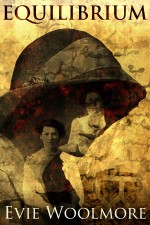
EQUILIBRIUM by Evie Woolmore (Available at all Amazon sites including Amazon UK and Amazon US)

internal_eq

“…original, poignant, illuminating…”  “a “fine yarn” where spirits, mystery and love waver …”  “…evocative writing…highly recommended…”

Epiphany and Martha are sisters with a stage mediumship act in Edwardian London. When they are asked to give a private reading at the home of Lady Adelia Lyward to find out the truth about her brother’s death, Martha must face up to her past. For two years ago, her affair with Lord Rafe Lyward ended in pregnant disgrace, and her attempted suicide in the River Thames. But there is more at stake than Martha’s anonymous return, for Epiphany bears the burden of restoring the equilibrium, not just to the Lywards but to her sister and ultimately to herself.

The Historical Novel Society review says “the story is rich in complex characters … I recommend “Equilibrium” to readers who enjoy historical fiction with spiritualist influences.” Equilibrium is also Awesome Indies Approved.

RISING UP by Evie Woolmore (Available at all Amazon sites including Amazon UK and Amazon US)

smaller_ru“…simple and beautiful, human and poignant…”   “…mystery, history and a bit of mysticism…” “….it’s one of the best books on the subject I’ve ever read…”

Tom Macindeor is an itinerant English teacher, spending the summer in Warsaw in the hope of finding out the truth about his grandfather, a Polish resistance fighter. But when he hears the voice of Ela, a young woman trapped in the Jewish Ghetto of 1942, a window opens not just on his past but the future of the ghetto and all those who live in it. Should he share what he knows of their fate, or will Ela’s search for the truth about her own family doom them both?

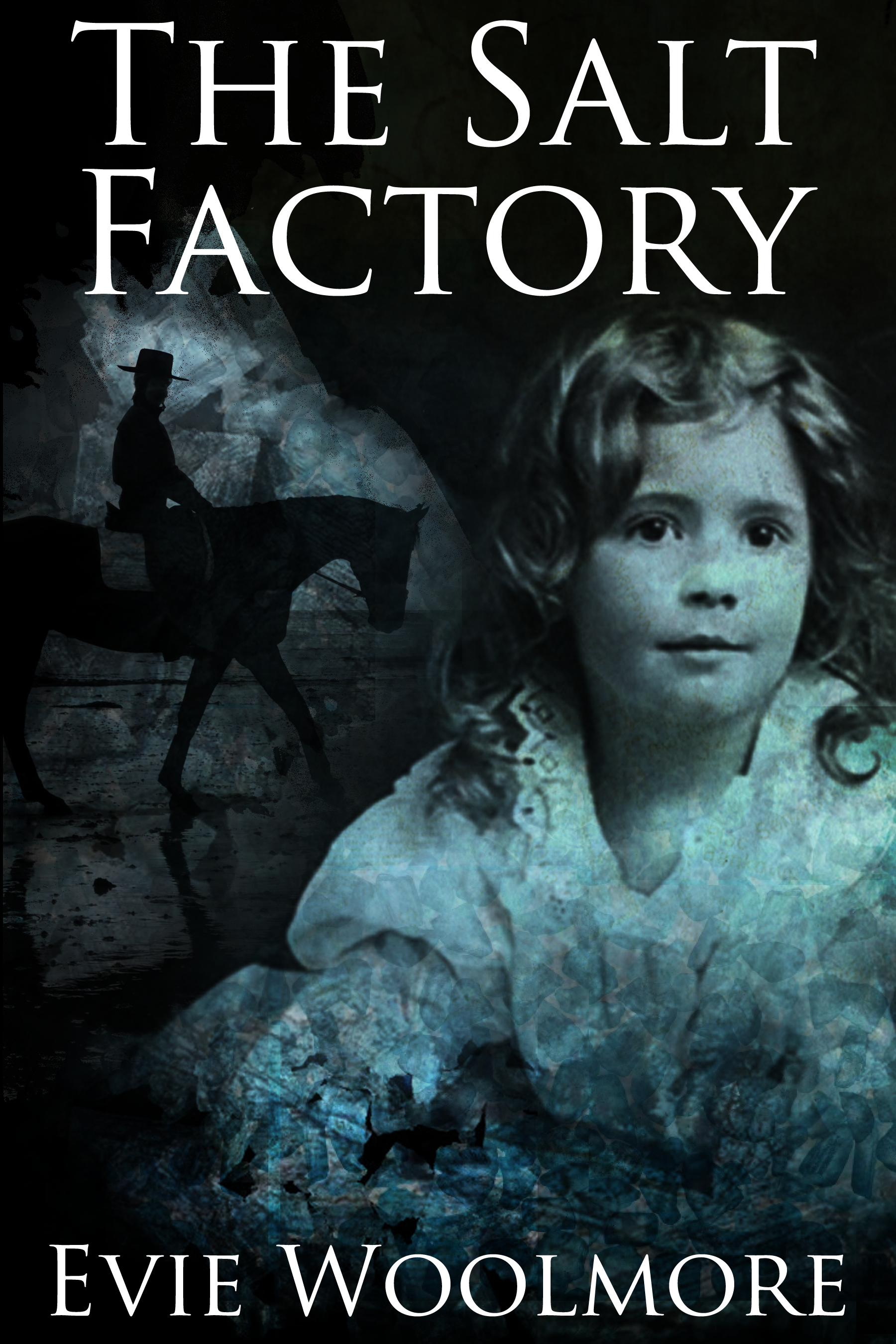
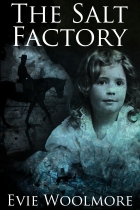
THE SALT FACTORY by Evie Woolmore (Available at all Amazon sites including Amazon UK and Amazon US)

salty9_option

Evie Woolmore’s latest stunning novel has just been published on Kindle, with a fabulous review at Read Dream Relax.

‘I never shoot a man unless there is no other choice.’

The motto of Thelonia Jones, deputy Marshall, makes perfect sense in the silver-mining mountains of Colorado. But back in Victorian England, hoping to settle the debts of her half-brother Cadell, Thelonia finds much that bewilders her. Why has her wealthy stepfather abandoned his mansion to die alone in a rundown cottage by the sea? Who is the strange little girl who brings seagulls and sick people back to life? And why has the owner of the Greatest Freakshow on Earth followed her halfway around the world? For all her ease around matters of life and death, even Thelonia will be surprised by just how high the stakes are about to get. They say the past always catches up with you. For Thelonia Jones, that means literally.

****

If you yearn to be a teenager again – or are one still – try Flora Chase‘s luxurious young adult historical saga:

THE STRATTONS by Flora Chase (Available at all Amazon sites including Amazon UK and Amazon US)

The Strattons vol 1 cover

The Strattons, the first volume of The Strattons young adult historical saga, is set against the backdrop of the luxurious late Edwardian era, on the eve of the First World War. Four young people, aristocrats and servant, are about to find their safe, comfortable world changed forever. Each must come to terms with the expectations of their class, their gender, and their destiny, and decide whether to embrace them or find the courage to fight against them.

When their diplomat father, the 4th Marquess of Stratton, is killed in Germany, Freddie, Julia and Blanche Matchingham, and their housemaid Dinah, find their world changed forever. Freddie must abandon dreams of university to become the 5th Marquess. Julia is wrenched from the contented obscurity of her books to face the nosy aristocracy keen to marry off her brother. Shallow, sociable Blanche finds her ambitions to take London by storm thwarted by mourning and social restriction. And why is Dinah, the first housemaid, suddenly being sent away from Stratton? The arrival of a German prince and a factory worker will turn all their worlds upside down and each of them must decide what their future holds, and whether they have the courage to face it.

Unknown's avatar

Indie Book Reviews (7)

The books reviewed by allonymbooks author Evie Woolmore this week share strongly imagined worlds.

Demon’s Grip by Tahlia Newland (Amazon UK and Amazon US)

DPeakDG2.2The third novel in the Diamond Peak series by Tahlia Newland is a somewhat different book to its two predecessors. Perhaps that is not surprising, for over the course of a series of books, the pacing will vary, and the narrative will bend and flex as it moves towards its concluding volumes. Unlike other serial novels, like the Harry Potter books, Ariel is on a long linear journey, and so the books will vary on that journey. Continue reading

Unknown's avatar

Terrific review of Evie Woolmore’s The Salt Factory at Read Dream Relax

The Salt Factory by Evie Woolmoreallonymbooks is delighted to share a wonderful review of Evie Woolmore’s latest novel The Salt Factory from the reader review website Read Dream Relax.

“The verdict. This is one indie author worth reading. I highly recommend The Salt Factory to historical fiction and paranormal fans.”

To find out more about The Salt Factory and read an article about it by Evie, visit The Salt Factory page. To buy a copy of The Salt Factory visit Amazon UK, Amazon US or any other worldwide Amazon site.

Unknown's avatar

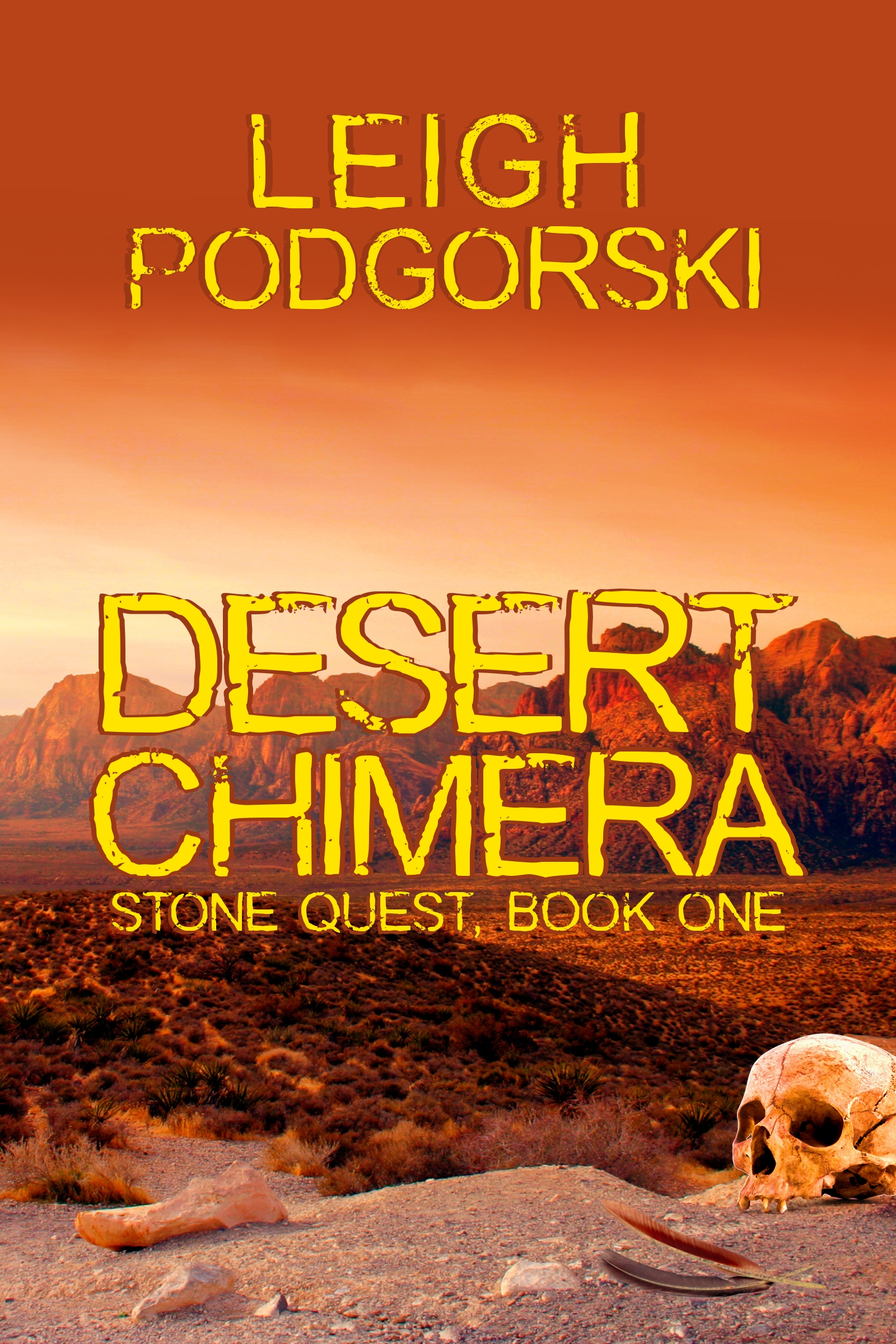
Interview with Leigh Podgorski, author of Desert Chimera

38d73-bloghopbuttonsmallAs the third and final contribution from allonymbooks to the Magical Realism Blog Hop, Evie Woolmore interviews fellow magical realist and spiritual author Leigh Podgorski about her influences and how her experiences have shaped her writing.

Evie Woolmore: Readers of Desert Chimera may not realize that it was originally created as a play. Indeed, they may not appreciate how prolific and talented an artist you are across a range of art forms. Why do you work in different media and how do those different outputs influence each other?

Leigh Podgorski

Leigh Podgorski: Though I have written short stories and dabbled in some poetry, the main media I have worked in is screenplays, stage plays, and novels. Different media demand different discipline. There is nothing like crafting a screenplay to teach the craft of economy, the art of lasering in to the high point or the very “kernel” of every scene you create. In a good screenplay there is no fat. Stage plays teach you how to craft dialogue and character behavior. If you cannot tell your story through behavior and dialogue you have no play. Both of these formats have rather strict rules and time limitations. I trained in the theatre and spent many years practicing the craft as an actress, writer, director and producer. I love the American master playwrights: Tennessee Williams, Eugene O’Neill, Clifford Odets, and Arthur Miller. The theatre is a community, collaboration. There is no discipline on earth that can duplicate the thrill of performing or having your words performed before a live audience. Of the three disciplines, however, novels are the freest of all forms. With the novel, there are no rules, no set format, and unless you are co-writing, no collaboration. There is you and your universe, as you populate it, as you create it. You can zoom inside your protagonist’s head, and turn around and zoom into your antagonists’; you can lead your audience back a thousand years or forward 10,000; you can create a whole new planet, a new country, a new county or city; you can even kill and resurrect if, and this is a very big if, you take your reader along for the ride, if you create a universe your readers believe in. In the theatre, if an actor breaks the fourth wall, that is the imaginary wall that separates the actor from the audience, the magic is broken and the audience is lost.  In a novel, if the author is unfaithful to her universe, if she writes something that causes her reader to no longer believe in the world she has created, the author has broken the magic, she has shattered the illusion, and the reader is lost.  In the end, whatever discipline I have worked in, I have learned that it is all story.  I am a storyteller.  Will my readers come along with me for the ride? Having worked in different mediums has enabled me to call on a variety of different skills to build my story universe and to check it for resonance and stability. If I am false, if I break the magic, my audience will tell me. My audience will be lost to me.

EW: That diversity also reveals itself in your fiction, for Desert Chimera and The Women Debrowska are extremely different books. Many have argued that publishing directly to Kindle and other e-book formats frees authors from the tyranny of having to stick to one genre, so I’m interested in how indie publishing has helped you as a writer?

LP: I have spent a lifetime as an artist; as an actress, writer, director, and producer. Most of that time has been spent in the theatre, and save for some extremely bad video recordings of plays, there is no lasting record of my theatre productions in any of the disciplines above except for typed manuscripts of my plays. I do have a film I wrote, directed, and produced that I adapted from my play entitled We Are Still Here about Cahuilla Elder Katherine Siva Saubel. From the time I began writing, and this includes stage play writing and screenplay writing, I remember hearing the argument: Do you write what you love, or write what sells? And of course there was the companion argument that an author must establish his or her “brand” in order to be able to market oneself. We have all heard the stories of well-known authors who write under pseudonyms when writing outside their genres. What the advent of Indie Publishing has done for me addresses many of these issues. First, Indie Publishing has enabled me to create a lasting record and product, for I am publishing not only e-books but print books as well. However, even as a Kindle and e-book publisher, Indie Publishing has enabled me to establish a growing Internet presence. With the technology available to us today, e-books can be quite stunning in design, as can Author’s pages. Marketing one’s work is not easy; it is often as consuming, if not more so, than writing, and writing is far more fulfilling and fun. When I am writing—as I am doing right now—I am in the midst of completing the third book in my Stone Quest series – I am able to accomplish very little if any marketing and vice versa, especially as I teach as well. There are only so many hours in the day. My goal is to make my presence so visible and my books so lucrative that I can become a fulltime writer with no need for any other job. Indie Publishing has given that dream hope. As for the question of what to write— what you love or what sells? Sometimes what you love becomes what sells. Sometimes what sells becomes what you love. Sometimes—none of it happens. “Hope is the thing with feathers” Emily Dickinson wrote. Indie Publishing has given me lots and lots of feathers. And that is a very very good thing
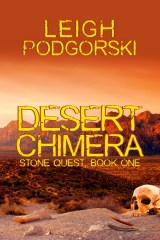
Desert Chimera by Leigh PodgorskiEW: Desert Chimera draws on a wide range of spiritual themes across several cultures. What inspired you to bring these together, first in the play and then the book?

LP: I have been fascinated with the metaphysical as long as I can remember. My favorite authors as a child were Poe and Asimov, and then, when I got a little older, Jung. I conducted research for a book Ouray’s Peak, about the Ute Indians. Their lives are so connected with the Earth and with nature in a way that non-native modern man is not.  I’ve also read a good deal of Tom Brown and his Tracker series; his influence can be seen in the characters of Luke and Grandfather. Armand Jacobi is an amalgamation of Anton LeVay, the creator of the Church of Satan, and L Ron Hubbard, the creator of Scientology. Both LeVay and Hubbard are fascinating men who created vast followings. Their spirituality, especially LeVay’s is dark, but they are charismatic, beguiling characters. I researched Satanism for some film scripts I was writing for a company that was producing horror films, and had read Messiah or Madman the book L Ron Hubbard’s son Ron deWolf wrote about him.  Eppie Falco is drawn from my work with Dr. Elisabeth Kubler Ross whom I interviewed for another play, Windstorm. Dr. Ross was a celebrated doctor who saw visions, communicated with the dead, and who, through her visions, taught us more about, as she said, not how to die, but how to live.  The play Desert Wolf was written about fifteen years ago. I was a member of a theatre company here in Los Angeles, and I developed it specifically for members of the company, one of whom is my husband, actor/director Dave Florek. Going from the play to the novel was very interesting. I had the opportunity to widen the scope and explore the spirituality of the characters far more intimately and deeply. This was especially true for Luke and Armand’s relationship while Luke lived with Armand and the lost boys in New York.

EW: What did writing the book offer you, in terms of exploring that huge range of material, that you couldn’t cover in the play?

LP: One of the largest frustrations I had with the play was the final showdown, the final duel between Armand and Luke in the Desert Wolf Café. No matter how brilliantly choreographed as a stage fight this scene could be, it could only remain a stage fight. Even if one could imagine all the wizardry of a high tech production of Wicked, and Desert Wolf had no hope of ever receiving anything close to a fraction of that budget, if it were to even be graced with a full production at all, when producing for the stage, one is, at the end of the day, limited by reality. What are the limits in a novel? Credulity, solely. Create your illusions sufficiently to entice your readers to believe in your magic, and you can take them anywhere.

EW: Finally, what one piece of advice would you share with other indie authors that you wish you’d known sooner?

LP: Write. Do not despair. Do not give up. It really does not matter if your book is # 2,987,342 on Amazon. It really does not matter if you never get to give up your day job. It really does not matter if nobody knows your name. Write because the only thing that really matters is your voice. Write because, besides breathing, eating, drinking, and sleeping, it is the only thing in all the world that you really have to do.

That’s a great piece of advice, Leigh, thank you! And thank you so much for giving up your time to talk to allonymbooks. 

You can learn more about Leigh and her work at her web site: www.violethillsproductions.com; or visit her Author’s Central Page @http://amzn.to/YomRl1Leigh can also be contacted via Facebook @ facebook/leigh.podgorski, @ twitter @ twitter/leighpod52.
*****

To read other blogs on the Magic Realism Blog Hop, please visit the other participating writers:

Zoe Brooks (and this one) – Kirsty Fox – Karen Wyld (and this one) – Leigh Podgorski – Tad Crawford

Lynne Cantwell – Murielle Cyr (and this one )- Joel Seath – Edie Ramer – Laura at Curated Bookshelves

Christine Locke – Susan Bishop Crispell – Jordan Rosenfeld – Eilis Phillips – Cadell Blackstock

and Evie Woolmore’s first blog hop blog

Evie reviewed Leigh’s novel Desert Chimera a few weeks ago. To find out about Evie’s own magical realist novels, please visit her page.
Unknown's avatar

Facts and fiction: Historical Magical Realism – Evie Woolmore’s blog for the Magic Realism Blog Hop

As part of the Magic Realism Blog Hop, running 22-24 July, allonymbooks author Evie Woolmore discusses her use of historical settings for her magical realist novels.

Almost a year ago, I responded to Robert Harris‘s lack of enthusiasm for magical realism. He said, “I enjoy recreating the concrete details of a society or a city or a country or a structure and then playing around with it. I’ve no taste at all for fantasy, or for magic realism. That’s garlic to a vampire as far as I’m concerned.”  I observed that Mr Harris seems to position his works as directly opposite to magical realism, “as if facts are somehow literally fatal to the genre or vice versa.” And yet, as I went on to say, “if one is to consider Mr Harris’s Fatherland or Pompeii, has he not merely done as I and other magical realist authors do: to take a position in our familiar world, and simply consider a new perspective on what we know? He calls it “playing around”. I call it a “what if?””

I recently published my third magical realist novel, The Salt Factory, and like its companions Equilibrium and Rising Up, it embraces a historical setting, this time England and Colorado in the early 1890s. And as my thoughts turned to what I am going to write next, I wondered whether there is something implicit in the historical setting that makes it an effective home for magical realism.

Zoe Brooks, host of this fabulous Magic Realism Blog Hop, defines magical realism on her website as “a literary genre that incorporates fantastic or mythical elements into otherwise realistic fiction.” Like most historical novelists, I strive for accuracy in my books, and spend hours researching the period, the geography, the vocabulary and so on to enable me to create as authentic a setting as possible, a setting that is, as Zoe describes, “realistic”. Yet why do I go to so much trouble to create an authentic historical setting when I’m going to be challenging the reader to think of that same world in a different way, because of the magical realist themes I introduce? Will you care that Thelonia Jones is wearing the correct Victorian knickerbockers when I’m going to introduce her (and you) to a little girl who can bring dead things back to life?

The Salt Factory by Evie Woolmore

I wonder if there is a veil of otherness and separation that falls over a novel when its setting is removed from us in time as well as in possibility, a veil that actually helps us believe more in the book’s magical qualities? In other words, if I set this story in a land far, far away in distance and time, isn’t it much more possible that the things I’m going to tell you happened actually did happen? Isn’t that far more likely than if I tell you this happened yesterday in a house around the corner from where you live, which might make you start thinking of reasons why it can’t possibly have occurred? It’s a wonderful paradox, typical of what makes fiction so fascinating, that while I strive to make you believe in the authenticity of the Victorian England I am painting in my novel, I am doing so just so you will feel more comfortable when I show you something very extraordinary in that world.

My motivation for writing has never been to find out how far I can stretch the boundaries of your imagination. I am not a creator of marvellous ‘worlds through secret doors’ like Tahlia Newland’s Diamond Peak or John Dutton’s Temple of Truth. The magical realist aspects in my novels do not exist in parallel to our world, they are right here in it. They are discoveries like electro-magnetism and radiation in the nineteenth century and the Higgs-Boson particle in the twenty-first, they are part of the fabric of this all-too-real world, visible all along if only you would just tilt your head a little further to one side and set yourself free of some of your pre-conceptions.

So perhaps I also like using a historical setting because it’s a way of lessening the shock. If I make you comfortable in a world by making it feel authentic, then you will be less disturbed when I reveal some of the hidden truths about that world. There is something very safe about historical fiction. We are escaping from this time and this world to one which seems less complicated, and through which the author leads us like an experienced tour guide. And so perhaps we are less troubled when unusual things happen there, for we can learn the lessons of that world, understand its characters, appreciate its themes, admire its vision, because it is a foundation for our world, and yet still safely separate from it.

~~~~~~~

To find out more about Evie Woolmore and her magical realist novels, please visit her page. You can read an extract from The Salt Factory here.
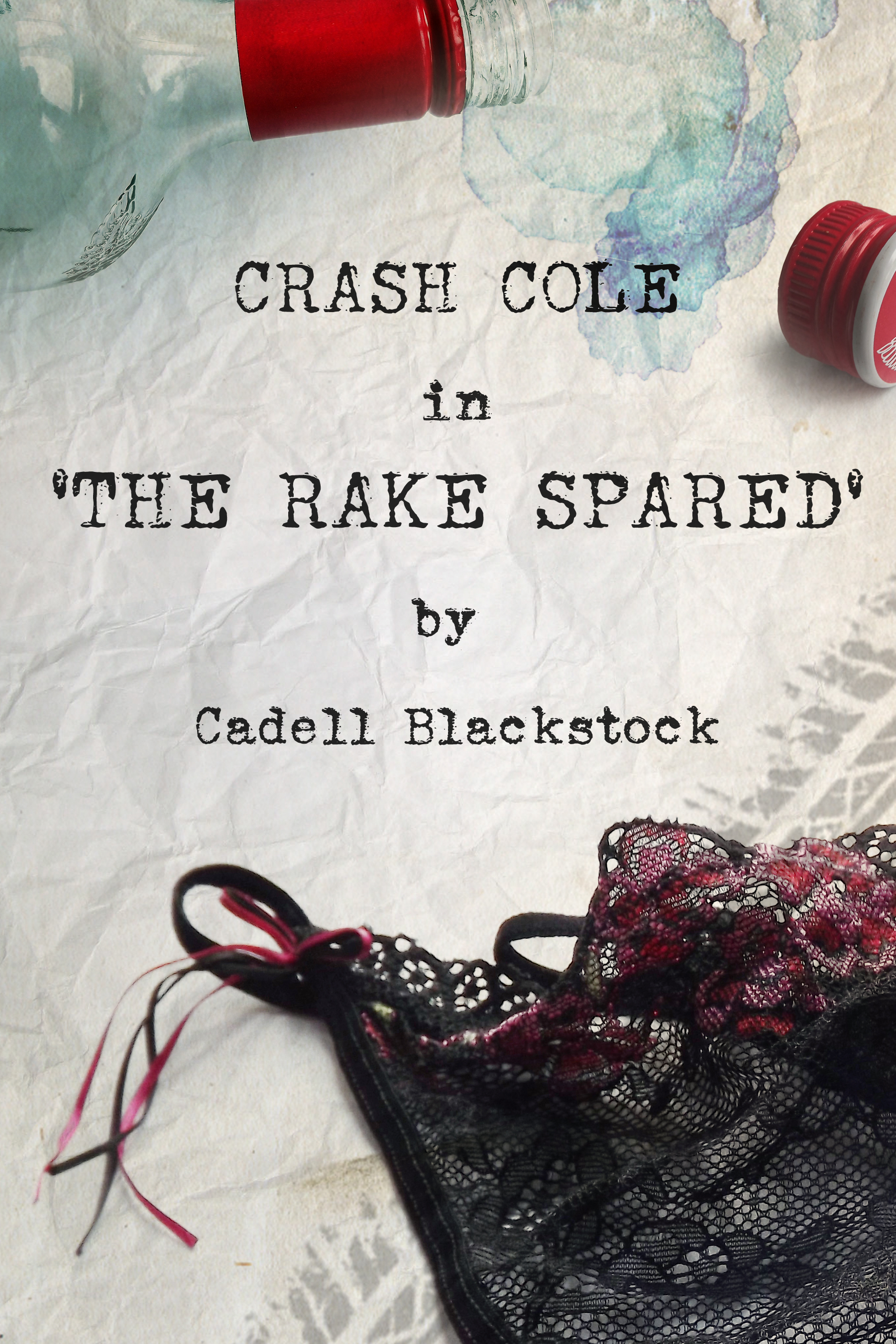
allonymbooks has also published a contemporary satire with a magical realist twist by Cadell Blackstock. Cadell has now blogged about ‘Magical Realism for Men’ as part of the blog hop. To find out more about Crash Cole in ‘The Rake Spared’, visit his page.

To enter the fabulous giveaway of magical realist books, including Evie’s novel Equilibrium, and a Franz Kafka bookmark, follow this link!

For Evie’s reviews of some other magical realist books, check out those listed on indie book reviews.

To read other blogs from allonymbooks on magical realism, try this tag.

To read other blogs on the Magic Realism Blog Hop, please visit the other participating writers:

Zoe Brooks (and Zoe’s second post and this one) – Kirsty Fox – Karen Wyld (and this one)

Leigh Podgorski – Tad Crawford – Lynne Cantwell – Murielle Cyr (and this one )- Joel Seath

Edie Ramer – Laura at Curated Bookshelves – Christine Locke – Susan Bishop Crispell

Jordan Rosenfeld – Eilis Phillips – Cadell Blackstock – and Evie Woolmore’s third blog for the blog hop

internal_eq The Salt Factory by Evie Woolmore smaller_ru

Unknown's avatar

The Salt Factory by Evie Woolmore: Exclusive Extract

To coincide with the recent publication of Evie Woolmore’s new novel The Salt Factory, this week’s blog is an extract from Chapter 1. To read the prologue and the rest of the novel, please visit Amazon UK, US or any other Amazon site.

salty9_option

   Lymington, July 1891 

I don’t want to look at the dead bird for a moment longer than I have to.

At least, I think it is dead. It has been lying very still for several minutes but now, as the little girl beside me reaches out for it, its cloud-white breast surely twitches. The horse shies and whinnies, tugging at the harness I hold, its head jerking and rolling as if witnessing the most violent decay.

I must have imagined the fluttering of the bird’s heart. Its eyes are glassy, and from the horrible angle of its head, twisted almost back on itself against the wet sand, I guess its neck is broken. If it isn’t dead now, it will be soon.

My revolver hangs against my leg, in the folds of my skirt. It would be easy to put the wretched bird out of its misery. It would make a mess on the beach, but the sea would wash it away. The little girl would have to leave first, of course, and that might take some talking.

Talking which I don’t feel like doing.

How the bird could have come to such a fate, I can’t imagine. It isn’t as though it could have fallen off a rock, because there aren’t any. Nor could it have flown into something, unless it mistook the hot glossy shimmer of the wet beach for the clear summer sky faintly reflected in it.

The day is hot and oppressive. If I close my eyes, I might be back home in Colorado but for the vinegary sweet smell of seaweed harvested by the low tide and the mourning cries of other seagulls. My damned corset grips stiff and damp to my ribs, the bustle hangs like a canary cage off my behind, and the petticoat drags like a wet blanket, weighed down even more by the revolver. I long for the loose poplin shirts and trousers I wore on the ranch, for the simplicity of my holster. But first impressions are first impressions. And if the Magnus I remember from my childhood is anything like the Magnus I am about to see again, he would never permit such a breach of ladylike disposition. It will be shock enough for him to see me again. Best not make it worse. Continue reading

Unknown's avatar

Magic Realism Blog Hop: 22-24 July 2013

Magic Realism Blog Hop

allonymbooks author Evie Woolmore is delighted to be joining Zoe Brooks’ Magic Realism Blog Hop which will take place later in July. Zoe writes a terrific blog about her own books and writing, but also regularly reviews a wide range of magical realism books from around the globe. If you’re looking to try your first magical realist book, or don’t quite know what the genre really is, then do check out her reviews for some excellent recommendations.

Among the other adult and YA authors already signed up to the Blog Hop are Awesome Indies’ Tahlia NewlandKirsty Fox, author of Dogtooth Chronicals (reviewed by Evie earlier this year); Eilis PhillipsJordan Rosenfeld  and  Chaunce Stanton. If you are a magical realist author and want to join the Blog Hop then visit Zoe Brooks’ website, and if you are a fan of reading then watch out for some book giveaways too!